
Cooling System Guides
How to Identify a Tractor Water Pump Before Ordering a Replacement
To identify a tractor water pump, first check the OEM or part number, then compare the old pump housing, mounting-hole pattern, pulley, hub or drive flange, hose outlet positions, gasket surface and machine details. Send clear front, rear and side photos before ordering so the part can be reviewed without guessing from symptoms or appearance alone.
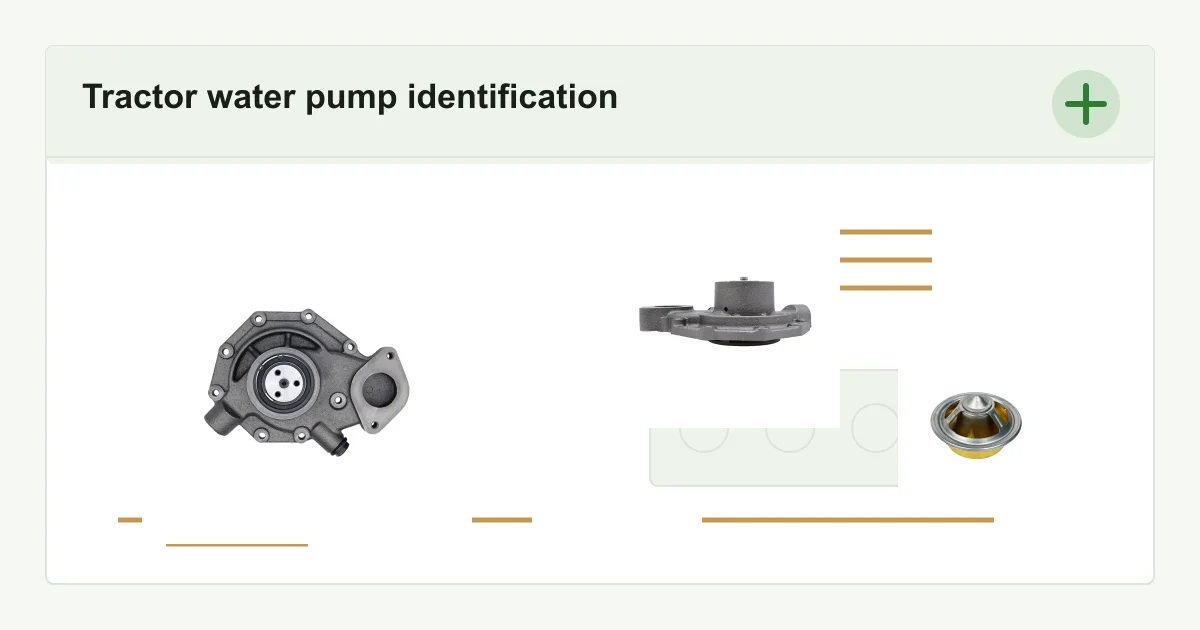
A tractor water pump replacement request should be based on part identity, not only on a cooling-system symptom. Leakage, overheating, noise or belt movement may lead a technician to inspect the water pump, but those signs do not prove that every pump with a similar shape is the right replacement.
For ARGODAYA sourcing, begin with the OEM number and old-pump photos. You can review cooling-system part references, including RE505980 Water Pump and DZ100555 Thermostat, or use OEM Lookup when a number is available.
How do I start with the OEM or part number?
Look for a stamped, cast, printed or label number on the old water pump, original box, invoice or parts catalog. Keep the exact formatting when you send it. If the number appears on a casting, photograph the whole casting area and a close-up of the mark.
If the old pump has been repainted or worn, do not scrape aggressively just to expose a number. Send what is visible and add machine model, engine information when known, serial number and photos of the removed part.
What should I compare on the pump housing and mounting pattern?
The housing shape and mounting-hole pattern are often the first visual checks when the OEM number is missing. Count the mounting holes, compare their positions, and photograph the pump from the engine side as well as the front.
Measure center-to-center distances only from the old pump or gasket surface. Do not publish or assume dimensions from product photos. A pump that appears close may still differ in bolt pattern, housing offset, bypass passage, or gasket shape.
How do pulley, hub or drive flange details affect a tractor water pump replacement?
Some water pumps are supplied with a pulley, some use a separate pulley, and some have a hub or flange arrangement that must align with the belt drive or fan. Compare the old pump front view, shaft or hub position, pulley groove type if visible, and whether the pulley is pressed on or bolted.
Belt alignment matters, but this guide does not give installation measurements or repair procedure. The buyer should send photos and let the part source compare visible details before quotation.
What should I check on hose outlets and connection positions?
Photograph every inlet, outlet, bypass connection and hose neck. Note whether the connection is straight, angled, upward, downward or offset relative to the mounting face. Include hose-clamp areas and any elbow or adapter still attached to the old pump.
If the hose arrangement has been modified, mention that in the inquiry. A replacement chosen only by the headline tractor model may not account for previous engine or cooling-system changes.
Why compare the gasket surface and housing shape?
The gasket surface shows the engine-side interface. Photograph it square-on and compare the outline, bolt holes, passages and sealing surface. If the pump uses an O-ring or separate gasket, show the old sealing part but do not assume a new pump includes the same pieces unless the product evidence says so.
Housing depth, impeller cavity and backing plate details can be hard to judge after installation. Clear removed-part photos are more useful than a single photo taken from above the engine bay.
Should rotation or drive arrangement be checked?
Check rotation, drive direction or special drive arrangement only when there is evidence from the old part, catalog, engine information or supplier documentation. Do not guess from blade appearance in a photo.
If rotation or drive arrangement is critical for a specific engine, the buyer should provide engine model, machine serial number, old-pump photos and any catalog reference. ARGODAYA will not turn that into an unsupported public specification.
What photos and measurements are needed for a tractor water pump?
Water Pump Inquiry Checklist
| What to send | Why it helps |
|---|---|
| OEM or part number | Best starting point for tractor water pump identification. |
| Front, rear and side photos | Shows housing, shaft, pulley or flange and outlet positions. |
| Engine-side gasket surface | Shows bolt pattern, passages and sealing outline. |
| Pulley, hub or fan-mounting photos | Helps compare drive arrangement and visible alignment features. |
| Hose outlet photos | Shows inlet, outlet, bypass and hose-neck orientation. |
| Machine model, engine details and serial number | Provides application context for cooling-system variations. |
What are common ordering mistakes?
- Ordering an aftermarket tractor water pump from the tractor model only.
- Assuming overheating always proves the pump is the cause.
- Ignoring pulley, hub, flange or fan-mounting differences.
- Sending only a front photo and omitting the engine-side gasket surface.
- Assuming a gasket, O-ring, pulley or hardware is included without product evidence.
- Publishing or relying on dimensions that were guessed from photos.
Related cooling-system references
For listed ARGODAYA cooling-system references, browse Cooling System Parts. The RE505980 Water Pump page is a related water-pump example, and DZ100555 Thermostat is a separate cooling-system reference. These links do not imply that the two products replace each other.
Sourcing inquiry CTA
Send the water-pump number, front and rear photos, mounting pattern, hose connections, machine model, engine details if known, quantity and destination country. If the old number is missing, add measurements from the old pump and photos of the gasket surface.
Request a water pump review
Share the old pump number, front and rear photos, mounting pattern, hose positions, machine model and quantity.
Send a cooling-system inquiryQuick Checklist
- OEM or part number
- Front, rear and side pump photos
- Mounting-hole pattern
- Pulley, hub or drive-flange details
- Hose outlet positions
- Gasket surface photos
- Machine model, engine details, quantity and country
Common Ordering Mistakes
- Ordering by symptom instead of part identity
- Missing the engine-side photo
- Assuming pulley or gasket inclusion
- Guessing dimensions from photos
Frequently Asked Questions
How do I identify a tractor water pump?
Start with the OEM or part number, then compare the pump housing, mounting holes, pulley or flange, hose outlets, gasket surface, machine model and old-part photos.
Can I order a tractor water pump by photo only?
A photo can help when the number is missing, but front, rear, side, gasket-surface and hose-outlet photos should be supported by machine and engine details.
Does overheating mean the tractor water pump has failed?
Not always. Overheating can have several cooling-system causes, so this guide focuses on identifying the replacement pump after the part has been selected for review.
What if the new water pump looks similar but the pulley is different?
Do not assume it will work. Send pulley, hub or drive-flange photos and ask for review before ordering.
Source Notes
- Official and dealer catalog examples were used to confirm that water pump pages commonly separate pumps, gaskets, pulleys, hose parts and serial or equipment context.
- This article is not a repair diagnosis guide and does not claim that any symptom proves water pump failure.
Send a parts inquiry
Include the OEM number, machine model, serial number, old part photos, quantity, and destination country for application review.