
Buyer and Sourcing Guides
How to Source Tractor Parts from China: A B2B Buyer's Checklist
To source tractor parts from China, start with OEM numbers, old-part photos, machine details, quantity, and destination country. Then verify the supplier's product understanding, request evidence for dimensions or materials, and inspect samples or a first order before scaling.
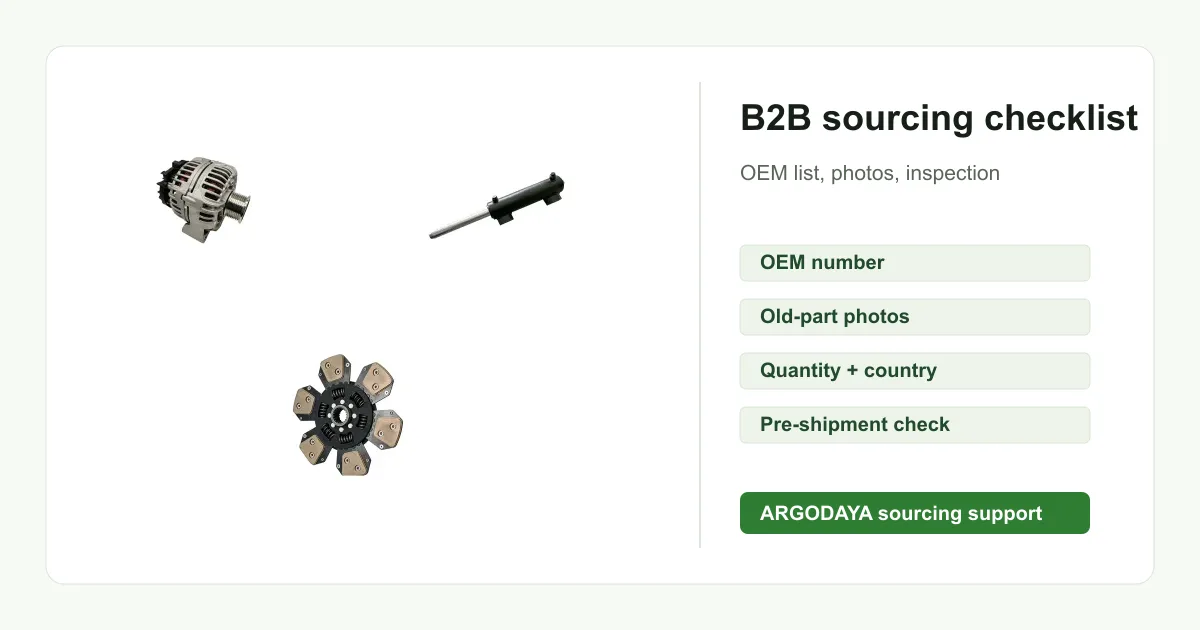
A reliable tractor parts inquiry starts before the first quotation. Buyers should prepare the OEM number, machine brand and model, serial number when available, old-part photos, quantity, and destination country. This helps an independent agricultural machinery replacement parts supplier review the part by reference instead of guessing from a broad product name.
ARGODAYA supports OEM-number-based sourcing for agricultural replacement parts. The goal is not to claim official brand authorization or universal fit. The goal is to help distributors, repair shops, importers, and farms prepare a clear RFQ so the part reference, visible details, and quotation conditions can be checked before order confirmation.
If you already know the part number, start with the OEM Lookup. If you have many items, prepare a spreadsheet and use the Sourcing service or Contact page to send the list with photos.
What Buyers Should Prepare Before Contacting a Supplier
The best tractor parts suppliers do not work from a single vague request such as "hydraulic part for tractor". They need enough information to identify the replacement reference, check visible details, and decide whether a quotation can be prepared responsibly.
For each line item, include the OEM number or part number exactly as shown, the machine brand reference, model, serial number or production year if available, product name, quantity, destination country, and any packaging or label requirements. If the number is unclear, add close-up photos of the old part and the area where it mounts.
A mixed order can still be efficient if the list is structured. Put one part per row, keep the OEM number in its own column, separate quantity from notes, and attach image filenames that match the row. This reduces confusion when the list contains filters, electrical parts, hydraulic cylinders, linkage parts, belts, clutch parts, and seals together.
What to Send / Why It Matters
| What to send | Why it matters |
|---|---|
| OEM or part number | The safest starting point for sourcing, lookup, and cross-reference review. |
| Machine model and serial number | Helps identify production changes, regional versions, and serial-range differences. |
| Old-part photos | Shows label, shape, mounting, connector, port, pulley, spline, or seal details. |
| Quantity and destination country | Affects quotation, packing plan, shipment method, and export documentation review. |
| Excel or itemized list | Keeps mixed orders organized and reduces back-and-forth for repeated demand. |
| Critical dimensions | Useful for filters, belts, cylinders, clutch discs, linkage parts, and non-labeled parts. |
Why OEM Number, Model, Serial Number and Photos Matter
The OEM number identifies a component reference. The machine model identifies a machine family. The serial number can narrow production changes. Photos show whether the old part visually matches the reference being quoted. These details answer different questions, so sending all of them is better than sending only one.
A tractor model can use different parts across production years, engine options, axle versions, transmissions, market regions, or previous repairs. This is why an RFQ should not rely only on the model name. For more detail, read OEM Part Number vs Model Number vs Serial Number and Why the Same Tractor Model May Use Different Parts.
When the number is missing, photos become the evidence trail. A full view, close-up of markings, mounting points, connector, ports, teeth, spline, seal profile, and packaging can prevent the supplier from quoting a part that looks similar but will not install correctly.
How to Judge Whether a Supplier Understands the Product
A supplier who understands agricultural replacement parts should ask focused questions. For an alternator, they may ask about voltage label, pulley, mounting ears, and rear connector. For a hydraulic cylinder, they may ask for closed length, stroke, rod diameter, ports, and end fittings. For an air filter, they may ask for length, end-cap style, and seal shape.
A weak supplier may answer every request with "yes, compatible" without asking for the OEM number, old-part photos, quantity, or application details. That is a red flag. A cautious answer is often better than a fast unsupported promise.
Ask how the quotation was matched. Was it matched by OEM reference, supplier catalog, dimensions, old-part photos, or a previous order record? The answer should be specific enough to show the supplier is reviewing the part, not only copying a keyword from the inquiry.
Supplier understanding checklist
- Can explain whether the quotation is based on OEM reference, visual comparison, measurements, or catalog evidence.
- Asks for serial number or photos when the application can vary.
- Does not claim genuine OEM status unless there is a real authorized supply channel.
- Can separate product identity from model compatibility.
- Can discuss packaging, labeling, quantity, and inspection before shipment.
Genuine, OEM-Reference Replacement and Aftermarket: Use the Terms Correctly
A genuine OEM part is supplied by or through the original equipment manufacturer. An OEM-reference replacement is sourced by using an OEM number as the identification reference, but it is not automatically genuine OEM. An aftermarket replacement is made by an independent supplier and may be selected by OEM reference, dimensions, product type, or cross-reference.
For international sourcing, this distinction protects both buyer and supplier. If a quotation is for an aftermarket tractor part, it should not be described as genuine OEM. Brand names and OEM numbers should be used for identification only unless official authorization is specifically proven.
ARGODAYA uses brand references and OEM numbers for identification and application review. It is an independent agricultural machinery replacement parts supplier and does not represent John Deere, Case IH, New Holland, Kubota, or other brands.
Verify Material, Dimensions, Hardness, Interface and Mounting Position
Not every part can be checked by the same method. Filters are often reviewed by size, end-cap design, seal shape, and media type when known. Belts require length, width, profile, and application review. Clutch discs may require outside diameter, spline count, hub profile, and both-face photos. Hydraulic parts may require thread, port position, stroke, rod diameter, and end fitting dimensions.
Material and hardness should only be stated when the supplier has reliable information. If a critical part depends on heat treatment, rubber compound, pressure rating, or electrical specification, ask for available technical details and agree how the first order will be checked. Do not invent material grades or performance claims just because the part name looks familiar.
Mounting position is often overlooked. Left-hand and right-hand parts, front and rear versions, or regional assemblies may appear similar in a catalog list. Old-part photos from multiple angles help the sourcing team compare what is visible before committing to a quotation.
Sample and First-Order Testing
For a new supplier or uncertain reference, start with a sample or a controlled first order when the business situation allows. A sample can help confirm visible geometry, packaging, label clarity, and basic workmanship before a larger mixed shipment.
A first order should be treated as a controlled validation step, not a proof of universal compatibility. Record the OEM number, supplier reference, batch, packing photos, and buyer feedback. If the item is installed successfully, keep the evidence with the purchase history for future repeat orders.
For high-risk parts, the buyer may need local inspection, dimensional checks, or installation review before repeat ordering. ARGODAYA can help organize the inquiry information, but final suitability still depends on the machine details and the buyer's confirmation.
Mixed Orders, Low MOQ and B2B Repeat Demand
Many agricultural parts buyers do not need one container of a single item. They need mixed orders: filters, belts, electrical components, seals, clutch parts, linkage parts, and hydraulic parts for multiple customers. Mixed orders work better when the buyer sends a clean Excel list and groups similar products together.
Low MOQ sourcing is easier when the part identity is clear and the buyer can accept practical packing conditions. For rare parts, the supplier may need extra time to confirm availability, cross-reference options, or production feasibility. Avoid sending a list of unclear names without OEM numbers and expecting a firm quotation.
Buyer Checklist
| Checklist item | Ready? |
|---|---|
| One row per OEM number or part reference | Yes / No |
| Photos named to match each row | Yes / No |
| Quantity, destination country and preferred shipping method included | Yes / No |
| Critical dimensions or connector details included for unclear items | Yes / No |
| Brand references used only for identification | Yes / No |
| Sample or first-order inspection plan agreed for new parts | Yes / No |
| Packaging, labels and carton marks confirmed | Yes / No |
| No unsupported genuine OEM or compatibility claims required | Yes / No |
Packaging, Labeling and Batch Management
Packaging is part of B2B sourcing. Buyers should specify whether they need neutral packaging, item labels, carton marks, barcode labels, or palletized shipment. If labels include OEM references, they should be used for identification and must not imply brand authorization.
For repeat demand, keep batch records. Store the supplier reference, date, quantity, packing photos, and any inspection notes. If a future batch changes packaging or appearance, the buyer can compare it against the previous accepted order.
Pre-Shipment Inspection Checklist
A pre-shipment check should focus on what can be reviewed without making unsupported performance claims. The supplier can confirm quantity, visible part type, packaging condition, label information, carton marks, and sample dimensions where practical.
- Count quantity by item and carton.
- Photograph representative parts before packing.
- Compare visible shape, ports, mounting, connectors, spline, pulley or seal areas against approved samples or photos.
- Check carton labels and buyer item codes.
- Confirm packaging protects fragile, machined, rubber, or electrical parts.
- Confirm shipping marks, gross weight, carton count, and destination details.
- Hold shipment if a visible detail conflicts with the approved reference.
Common Procurement Red Flags
The biggest red flag is a supplier who confirms everything without information. Another is a quotation that uses brand names aggressively but cannot explain whether the part is genuine, aftermarket, or OEM-reference replacement. A third is a supplier who refuses to compare photos or dimensions for a part where fit can vary.
- Claims of 100% compatibility without serial number, old-part photos, or catalog evidence.
- Use of genuine or official wording without proof of authorized supply.
- No willingness to identify whether a part is aftermarket or OEM-reference replacement.
- No itemized quotation for a mixed order.
- No clear packaging, batch, or inspection process.
- Pressure to order quickly before basic part details are confirmed.
How to Send an OEM List to ARGODAYA
For a single item, use the OEM Lookup first. If the number is not listed, send an inquiry with photos and machine details. For multiple items, send an Excel list with OEM number, product name, quantity, destination country, and linked image filenames.
ARGODAYA can review the list for OEM-number-based sourcing and replacement part reference support. The team may ask for more photos, dimensions, serial number information, or packaging requirements before preparing a quotation.
Prepare a tractor parts RFQ
Send OEM numbers, old-part photos, quantities, and destination country so the sourcing team can review the next step.
Send a sourcing requestQuick Checklist
- OEM number or part number
- Machine model and serial number
- Old-part photos
- Quantity and destination country
- Packaging or label requirements
- Sample or first-order inspection plan
Common Ordering Mistakes
- Using genuine OEM wording for aftermarket replacements
- Sending a mixed order without itemized rows
- Confirming compatibility from model name alone
- Ignoring packaging and batch records
Frequently Asked Questions
How do I find a reliable tractor parts supplier in China?
Start with a supplier who asks for OEM numbers, old-part photos, machine details, quantities, and destination country. A reliable supplier should explain whether the quotation is based on OEM reference, visual comparison, dimensions, or catalog evidence.
Can I buy tractor parts from China by OEM number only?
An OEM number is the best starting point, but it should be supported by machine model, serial number when available, old-part photos, and quantity. Some parts vary by production year, regional version, or previous replacement history.
Does OEM-reference replacement mean genuine OEM?
No. OEM-reference replacement means the OEM number is used for identification. It does not automatically mean the part is genuine OEM or supplied by the original equipment manufacturer.
What should I send for a mixed order?
Send one spreadsheet row per item with OEM number, product name, quantity, destination country, and image filename. Attach clear photos and add dimensions for parts where fit depends on shape, connector, port, spline, or seal details.
Should I order samples before a larger tractor parts order?
For a new supplier, uncertain part, or critical component, a sample or controlled first order is recommended when practical. The buyer should compare visible details and keep records before scaling repeat demand.
Can ARGODAYA source every tractor part?
No supplier can responsibly promise every part. ARGODAYA can review OEM numbers, photos, quantities, and destination details, then advise whether a quotation or further confirmation is practical.
Source Notes
- Google Trends data is relative search-interest data, not monthly search volume.
- Official brand parts catalogs commonly use model, serial number, and part-number lookup workflows; buyers should verify specific applications in authoritative catalogs when available.
Send a parts inquiry
Include the OEM number, machine model, serial number, old part photos, quantity, and destination country for application review.